Alkhwarizmi: The Grandfather of Artificial Intelligence
From 9th Century Baghdad to Modern Computing
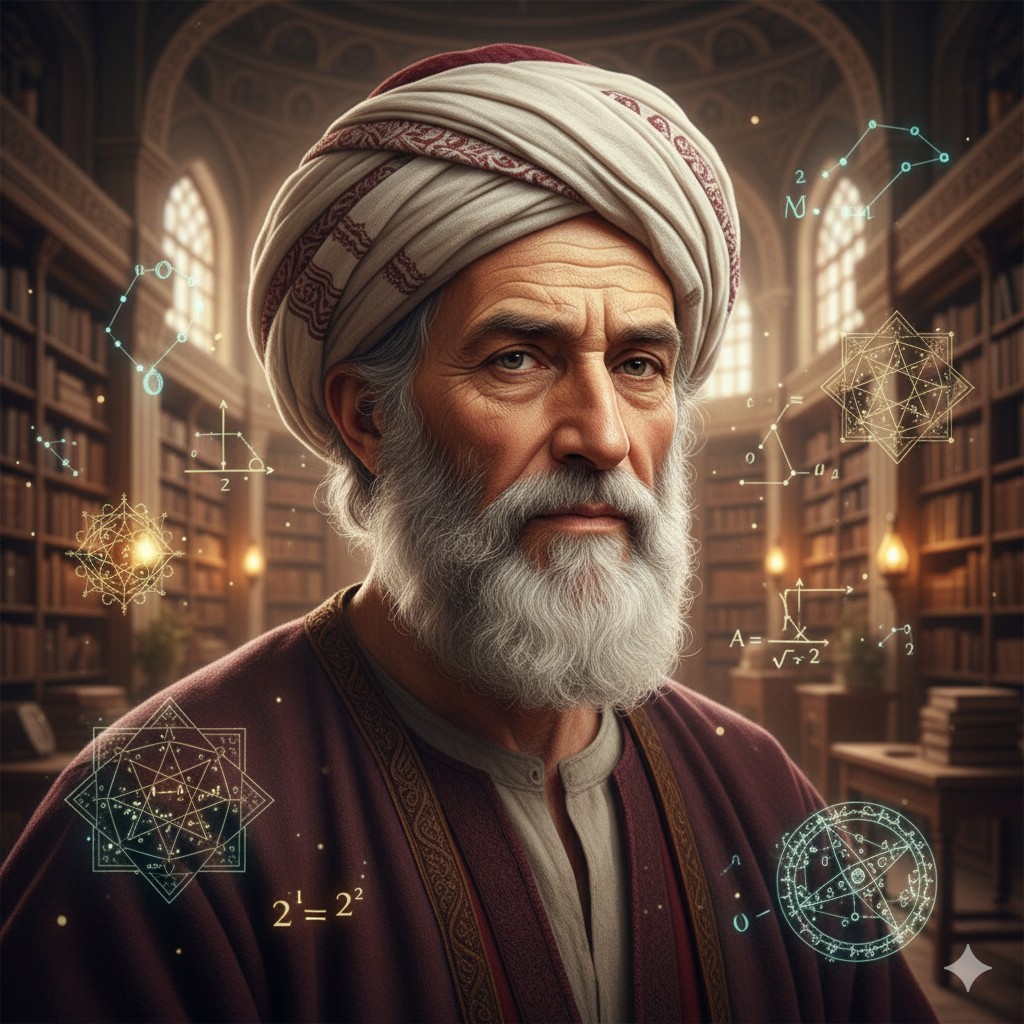
Key Contributions
- Developed systematic algorithms
- Father of Algebra
- Introduced Arabic numerals to West
- Pioneered decimal & zero concepts
- Foundation of modern computing
- Islamic Golden Age scholar
The Legacy
Muhammad ibn Musa Alkhwarizmi, often referred to as the "Father of Algebra," is a pivotal figure in the history of mathematics and science. His contributions, particularly in the development of algorithms, have earned him the title of the "Grandfather of Artificial Intelligence."
The Birth of Algorithms
In his seminal work, Al-Kitab al-Mukhtasar fi Hisab al-Jabr wal-Muqabala (825 AD), he systematically presented methods for solving linear and quadratic equations. This work introduced the concept of algorithms as step-by-step procedures for solving problems, marking a significant advancement in mathematical thought that would become fundamental to computer programming.
Revolutionary Impact on Modern Technology
🧮 Algorithmic Thinking
Systematic procedures forming the basis of all programming and AI systems
🔢 Numerical Innovation
Decimal system & positional notation essential for modern computing
🤖 AI Foundations
Logical frameworks enabling machine learning and automated systems
📐 Mathematical Legacy
Algebraic methods underpinning engineering, physics, and computational sciences
Impact on Artificial Intelligence
The algorithms developed by Alkhwarizmi are foundational to contemporary computer science and AI. Today's algorithms govern everything from social media feeds to self-driving cars, machine learning systems, image classification, and data analysis. Every neural network and AI system traces its conceptual roots back to his revolutionary work.
Alkhwarizmi was also instrumental in introducing the Arabic numeral system to the Western world, including the concept of zero and positional notation—crucial for modern computing and binary code systems.
Enduring Legacy
Despite living over a millennium ago, Alkhwarizmi's legacy endures as a cornerstone of mathematics and computer science. His work at the House of Wisdom in Baghdad during the Islamic Golden Age preserved and advanced human understanding. As we navigate an increasingly algorithm-driven world, his innovative approach to problem-solving continues to resonate, reminding us that the foundations of our digital age were built on ancient scholarship.